
Your Simple Guide to MikroTik Certifications: From Beginner to Pro
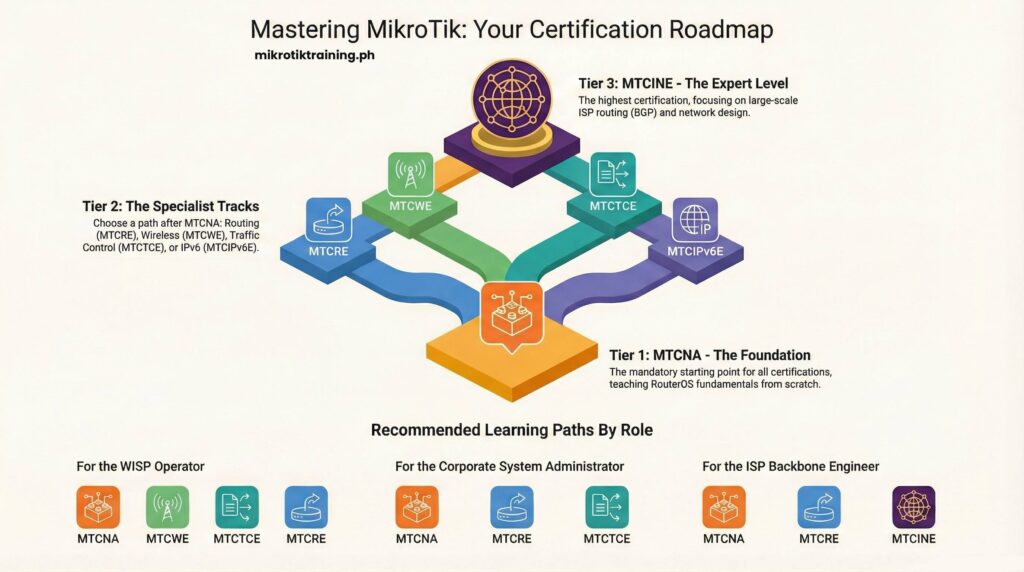
Introduction: Why Learn MikroTik the Right Way?
If you’re ready to move beyond basic, consumer-grade networking, you’ve come to the right place. MikroTik’s RouterOS is an incredibly powerful and widely used platform for building everything from small office networks to large internet service providers. However, a common challenge is that many networks are set up to simply “work” but are not engineered correctly for stability, security, and performance. This can lead to common frustrations like dropped video calls, slow file transfers, or unexplained network outages, even when the internet speed is high.
The MikroTik certification system provides a structured roadmap to fix this. It’s designed to transform learners from basic users into proper network engineers who understand and apply industry best practices.
1. The Essential First Step: MTCNA – Your Foundation
🟦 MTCNA: MikroTik Certified Network Associate
MTCNA is the mandatory prerequisite for all other certifications and serves as your “Gateway to RouterOS.”
The most important benefit of this course is that it replaces guesswork with a structured understanding of how the system operates. Instead of relying on the simple “Quick Set” wizard, you will learn how to configure a router from a completely blank state, giving you total control and insight.
Key Skills You Will Master:
• RouterOS Access (WinBox, CLI, etc.): Learn all the ways to connect to and manage your router, ensuring you can always gain access.
• Connectivity (WAN and LAN setup): Build the essential bridge between the global internet (WAN) and your local users (LAN), ensuring data flows correctly and reliably.
• Security Basics: Protect your router from unauthorized access by applying fundamental firewall rules.
• Bandwidth Control (Simple Queues): Learn to manage and limit internet speeds for different users or departments.
• Wireless Basics: Configure a secure and functional wireless access point for Wi-Fi access.
• Troubleshooting Tools: Master the built-in tools to diagnose and solve common network problems effectively.
Without MTCNA, advanced topics are nearly impossible to understand or troubleshoot because this course teaches you to speak the fundamental “language” of RouterOS.
Once you have this solid foundation, you can begin to specialize based on your career goals.
2. Choosing Your Path: The Specialist Tracks
After completing MTCNA, you can branch out into specialized fields. While the three most common paths are Routing, Wireless, and Traffic Control, further specializations exist for Security and IPv6.
| Certification | Core Focus | Ideal For |
| MTCRE (Routing) | Connecting multiple networks, offices, and building the network’s backbone. | Corporate Network Administrators, ISP Core Engineers |
| MTCWE (Wireless) | Mastering the physics of stable wireless connections for deployments like WISP. | WISP Installers, Outdoor Wireless Integrators |
| MTCTCE (Traffic Control) | Managing user experience (QoE) by prioritizing traffic and preventing congestion. | Network Managers handling performance complaints |
🟩 MTCRE: MikroTik Certified Routing Engineer
This is the essential course for engineers who manage networks with multiple routers, such as those connecting different branch offices or building the core of an ISP.
• Static Routing: Master the manual control of network paths, essential for simple, predictable networks and for creating robust failover rules.
• Dynamic Routing (OSPF): This skill turns your routers into a team that automatically shares a ‘map’ of the network. If one path goes down, they instantly find the next best route, preventing manual reconfiguration during an outage.
• VPN & VLANs: These skills are essential for securely connecting different sites over the internet (VPN) and for segmenting internal network traffic for security and organization (VLANs).
🟩 MTCWE: MikroTik Certified Wireless Engineer
This course teaches that successful wireless networking is based on the physics of radio waves, not guesswork. It is critical for anyone deploying outdoor wireless links.
• Radio Fundamentals: This teaches you how to properly plan a wireless link using essential concepts like Fresnel zones and link budgets, ensuring a stable connection from the start.
• Troubleshooting: This equips you with the knowledge to diagnose and solve common but frustrating wireless problems, such as signal interference and device alignment issues.
🟨 MTCTCE: MikroTik Certified Traffic Control Engineer
This course focuses on improving the Quality of Experience (QoE) for network users. It recognizes that high speed alone isn’t enough; traffic must be managed intelligently.
• Packet Flow Diagram: Learn the exact journey a piece of data takes through RouterOS. This is the foundational knowledge required to know where and why you should apply firewall or queue rules, preventing common configuration errors.
• Firewall Mangle: This skill allows you to “mark” specific types of traffic (like video calls, online gaming, or critical business applications) so the router can identify it.
• Advanced Queues: This is used to act on the marked traffic, allowing you to prioritize important data and ensure fair bandwidth sharing among all users.
Beyond these core specializations, the roadmap extends to future-proofing your skills and reaching the highest level of network engineering.
3. Looking Ahead: Advanced & Expert-Level Certifications
The learning path continues with advanced certifications that cover the future of the internet and the skills required for large-scale, ISP-level engineering.
MTCIPv6E (IPv6 Engineer) This course prepares engineers for the modern internet by teaching the deployment of IPv6, the official successor addressing the global exhaustion of IPv4 addresses.
MTCINE (Inter-networking Engineer) This is the highest-level certification, focusing on the carrier-grade routing technologies like BGP and MPLS used by senior ISP architects to design and manage the internet’s backbone.
4. Putting It All Together: Example Learning Paths
While everyone starts their journey with MTCNA, the subsequent steps you take will depend on your specific career.
Path A: The WISP Operator
Goal: To deliver internet wirelessly to subscribers.
1. MTCNA
2. MTCWE
3. MTCTCE
4. MTCRE
First, you must master building the wireless link (MTCWE), then you learn to manage the traffic flowing over it (MTCTCE).
Path B: The Corporate System Administrator
Goal: To manage office networks, VLANs, and secure VPN connections.
1. MTCNA
2. MTCRE
3. MTCSE (Security – optional but recommended)
4. MTCTCE
The priority for a corporate admin is connecting and segmenting the internal wired network (MTCRE), which serves as the backbone for all other services.
This clear progression shows how each certification builds upon the last to create a comprehensive skill set.
5. Start Your Journey
The MikroTik certification roadmap provides a structured, logical, and highly effective path to becoming a competent and confident network professional. By moving from a solid foundation to specialized skills, you can build networks that are not only functional but are properly engineered for the demands of the modern world.
Ready to begin? The first step for everyone is mastering the fundamentals in the MTCNA course.
